
APES Species Project
click on the buttons to go to that species!
HYACINTH MACAWS
Category: global, animal, endangered
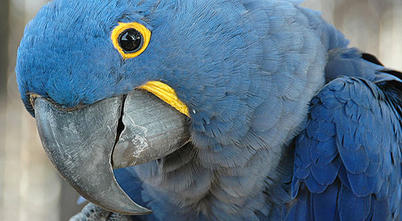
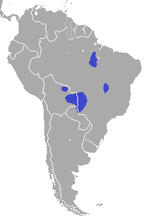
Background Information: Hyacinth macaws are a type of parrot that live in South American rainforests near rivers and swamps. They are extremely intelligent, and live up to 50-60 years in the wild, and up to 100 in captivity. Despite having an intimidating looking beak, they are herbivores, and forage for fruit, plant matter, seeds, and nuts. They are highly social animals who live in large flocks and communicate using a variety of loud squawks.
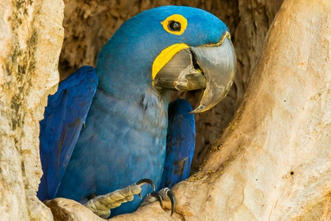
Identifying Characteristics: Hyacinth macaws are the largest macaw species, and are unique in that their face does not show any bare skin like other macaw species. Their beak is solid black, and they have yellow skin around their eyes and lower beak. In captivity, Hyacinths tend to be the most loving and pet-like out of all of the "domesticated" (it is impossible to domesticate a parrot) macaw species.
Reasons for Endangerment: Though technically restricted in the US, Hyacinth macaws are unfortunately involved in the pet trade. It is still legal in some areas to take in parrots caught against their will in the wild for profit. Even in areas where it is illegal, there is a large black market for pets -- especially exotic birds. Hyacinths rely on palm trees for habitat, are easy to find due to their noise, and are often in large groups, so capturing many of them at once is quite easy. As for countless other species, habitat destruction is also a large cause of the endangerment of Hyacinths. As stated earlier, their only habitat are palm trees, so when they are cut down, they have nowhere to go. Hyacinths do not breed often, and when they do have offspring many of them die due to being captured.
Possible Solutions: If you are considering getting a Hyacinth macaw, it is best to adopt a rescue from a sanctuary. Make sure that it is not a person selling it to you -- it is very likely that it was captured, and buying a captured species will make profit for illegal traders. Adopt, don't shop! Using recycled materials and not wasting paper is always a good idea, as it lessens the need for production of things made from trees.
PEREGRINE FALCONS
Category: in California, animal, threatened
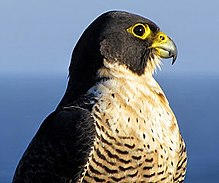
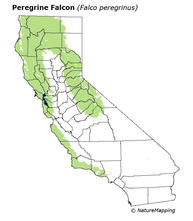
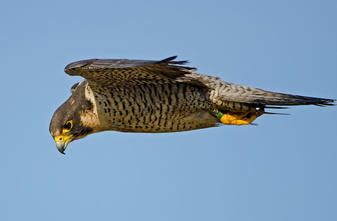
Background Information: Peregrine falcons are birds of prey that hunt smaller birds by "diving" mid-air. They live in coastal areas and/or by cliffs all over the US, but they thrive in California. They nest on cliffs and mate in the spring, with clutches of three to four eggs. 60% of peregrine falcon chicks will die in their first year of life, making their mortality rate quite high. They are solitary birds who only interact if they are courting or competing for resources.
Identifying Characteristics: Peregrine falcons are the fastest animals on the planet, flying up to 240mph. They are medium to large-sized birds. Peregrines have neutral-colored feathers, corresponding to their non-colorful habitat. Like every other bird of prey, they have four talons on each foot -- three in the front and one in the back.
Reasons for Threatened Status: In the mid-late 20th century, a pesticide known as DDT was accidentally consumed by many animals low on the food chain. Peregrine falcons are at the top of the food chain, so at the time a lot of their diet was poisoned. Adult peregrines died because of DDT, but many chicks could not be born because the chemical wears down the egg shells, preventing proper development.
Possible Solutions: The peregrine falcon population has been relatively stabilized when the use of DDT was banned in the US in 1972. However, they are still at risk for things that affect all species, like climate change. Since peregrines are at the top of the food chain they rely on everything below them to stay alive. If climate change affects the producer, for example, it will affect all of the consumers above it. So, as always, being environmentally considerate will benefit peregrines among every other living thing out there.
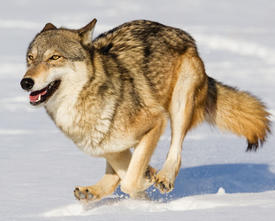
GRAY WOLVES
Category: in the US, animal, keystone species
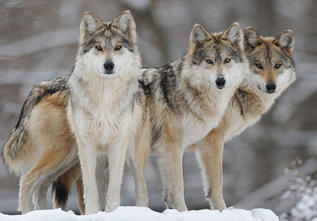
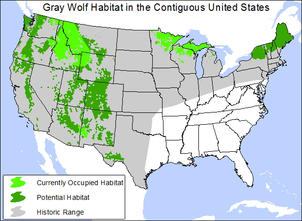
Background Information: Gray wolves are apex predators who hunt herbivores like elk, deer, rabbits, and beavers. They stay in smaller packs, consisting of 4-10 wolves with an alpha male and an alpha female. They live in cooler areas of the US, like Alaska, the Rockies, and are most commonly known to live in Yellowstone National Park. They mate in late winter, and have up to 7 pups at a time. Their gestation period is 63 days.
Identifying Characteristics: Wolves are large canids bearing resemblance to the domesticated husky and malamute. They use a variety of advanced communication skills within their packs, and each pack has a unique howl.
Reasons for Being a Keystone Species: Most apex predators have an influence on their ecosystem, but since wolves are not that populous, their influence is proportionally extremely large. They are the cause of boom-and-bust cycles, which affect both their direct prey (deer, rabbits, etc.), and indirect food (the plants that their prey eat). So, if anything happens to the wolf population, its ecosystem will drastically change.
Possible Solutions: In order to make sure the gray wolf population remains stable, doing small things like recycling and using products that do not come from trees can make a difference in preventing deforestation. Deforestation will affect the whole food chain through the bottom-up system, so the gray wolf population will most certainly be damaged.
MOSSES
Category: in the US, plant, indicator species
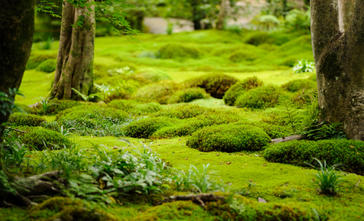
Background Information: Moss has existed on the planet for almost 300 billion years. It prefers moist environments, are quick to dehydrate. You can find it in most forests and some wetlands.
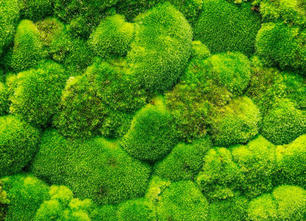
Identifying Characteristics: True moss are large clumps of little bright green leaves that attach themselves to forest floors. It does not have roots, and reproduce through spores. They help out other plants by giving them nutrients.
Reason for Being an Indicator Species: Moss absorbs water in the environment, so discoloration could indicate contaminated water. Water absorbed from soil may contain dangerous levels of nitrogen for the moss, which can indicate air pollution. Moss is all around a very delicate plant species, so it is a good place to check when environmental changes are suspected.
Possible Solutions: Using renewable energy rather than burning fossil fuels can bring an end to air pollution, and not using fertilizers can provide clean soil (and thus water) for moss.
ICE PLANT
Category: in California, plant, invasive species
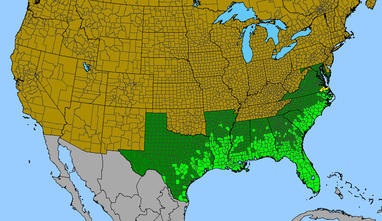
Background Information: Ice plant are native to South Africa, and were brought to California in the early 1900s, originally as a soil stabilizer.
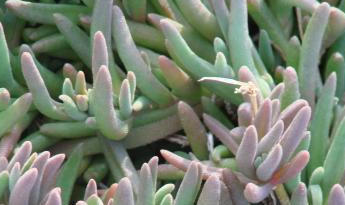
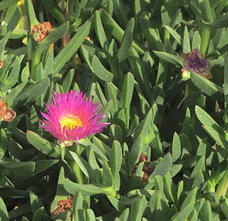
Identifying Characteristics: Ice plant have thick, meaty leaves, and have a relatively uniform flower distribution (usually one per plant). You can find them on California highways, but they are pretty much everywhere. It is a succulent, so it does not require much water, and has shallow roots.
Reasons for Being an Invasive Species: Ice plant is not native to California, so that automatically makes it invasive. More specifically, though, it spreads extremely quickly, taking up space where other native plants (that other species rely on for food or shelter) could have been. It also changes the soil composition, further affecting the other native species.
Possible Solutions: Do not plant ice plant in your backyard, or anywhere else! This poses a risk of it spreading, making it harder to be removed. There are many other native species that have the same aesthetic appeal as ice plant, so planting those instead is a smart option. There are many community service opportunities to help remove small patches of ice plant at a time, as it is simply not possible to mass-remove it.
Basic Facts About Gray Wolves. (2016, September 19). Retrieved from https://defenders.org/gray-wolf/basic-facts
Basic Facts About Peregrine Falcons. (2016, September 19). Retrieved from https://defenders.org/peregrine-falcon/basic-facts
Britannica, T. E. (2018, May 04). Moss. Retrieved from https://www.britannica.com/plant/moss-plant
Gaudinski, R. (2016, December 29). The Best Thing to Do with Ice Plant in California? Pickle it! Retrieved from http://www.mobileranger.com/santacruz/the-best-thing-to-do-with-ice-plant-in-california-pickle-it/
Home. (n.d.). Retrieved from https://nerc.ukri.org/planetearth/stories/819/
Hyacinth Macaw: An Endangered Species. (n.d.). Retrieved from http://www.bagheera.com/inthewild/vananimmacaw.htm
Invasive to Avoid: Iceplant. (n.d.). Retrieved from https://www.wildlife.ca.gov/Conservation/Plants/Dont-Plant-Me/Iceplant
Wolves, A Keystone Species. (n.d.). Retrieved from https://www.livingwithwolves.org/wolves-a-keystone-species/